Two Girls - 1984
Two Girls - 1984
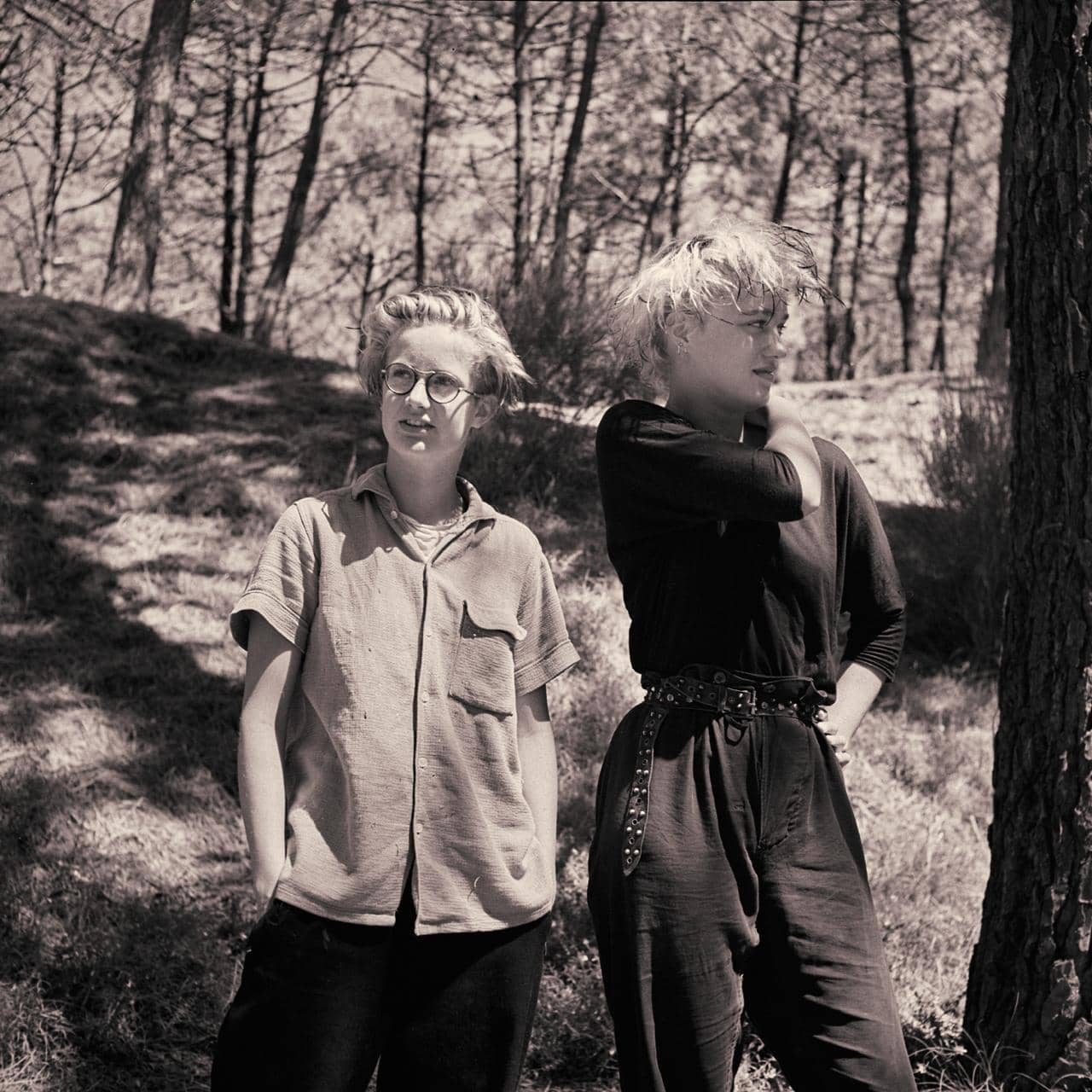
Two girls stand among trees, sunlight speckling the ground. The girl on the left wears round glasses and a button-up shirt, hands in pockets, looking somewhere just past the frame. The girl on the right leans against a trunk, bleached hair messy, a studded belt cinching her dark clothes. She is caught in profile, her attention turned away.
The belt is the loudest thing here. It pulls the eye before the faces do. Its metal studs catch the light in tiny, sharp points, a deliberate punctuation against the softness of the forest and the casual drape of her clothes. It feels like a declaration worn on the hips, a piece of costume that insists on being seen.
Yet the photograph itself refuses that insistence. The light is dappled, accidental-seeming. The girls are not performing for the camera; they are caught in a moment of waiting, or of being between things. Their separate gazes create a quiet distance between them, a gap the composition does not try to bridge. This is the tension: the belt shouts, but the picture listens.
It would be easy to read this as a document of a subculture, a snapshot of a style. But the framing denies that. The trees are slender, the background shallow. This is not a scene about place, but about presence. The girls are present in their own thoughts, absent from each other, held together only by the rectangle that contains them. The studded belt becomes less a symbol of rebellion and more a formal weight, an anchor keeping the right side of the frame from floating away.
I am not sure the picture needs the belt to do that much work. But its insistence is what makes me look twice, and then a third time, at the space between the two girls, which is where the photograph actually lives.