Sitting Baby - 1992
Sitting Baby - 1992
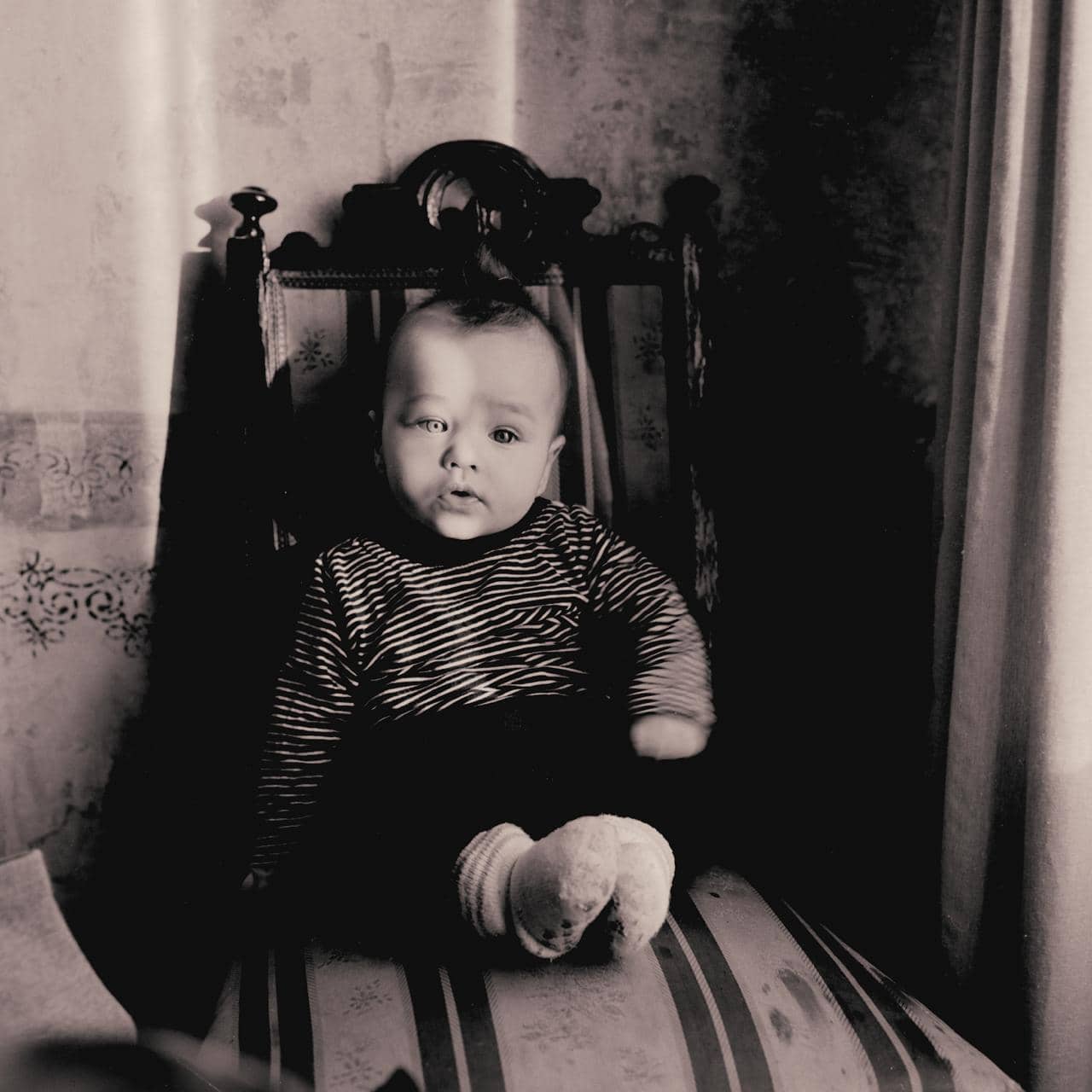
The baby sits straight in a dark carved chair, its striped shirt and pale socks the only softness in the frame. The chair’s high back towers like a throne; the wood is ornate, almost ecclesiastical. Behind, a textured wall and a draped curtain suggest a domestic stage. The baby looks directly at the camera, eyes wide, mouth slightly open—not smiling, not crying, just looking.
The title points to Velázquez’s portrait of Sebastián de Morra, the court dwarf seated on bare ground. Here the chair replaces the ground, the baby replaces the dwarf. The original painting forced dignity onto a figure treated as entertainment; here the baby’s gaze holds curiosity, not defiance. The reference feels borrowed, a ready-made art-historical tension.
What does this borrowing do? In 1992, Nieuwenhuys was deep into digital archives and networked image kits. This photograph might be a kit item: a baby, a chair, a reference. The composition is clean, the lighting soft, the contrast gentle. It is almost too polite.
I distrust the easiness of the art-historical game. Yet the baby’s open mouth—as if about to speak, or cry—disturbs the calm. That small detail refuses to be merely a quotation. It insists on something present, something not yet captured by the reference. The photograph works not because of Velázquez, but because of that open mouth.