Father and Son in musée d'orsay - 2025
Father and Son in musée d'orsay - 2025
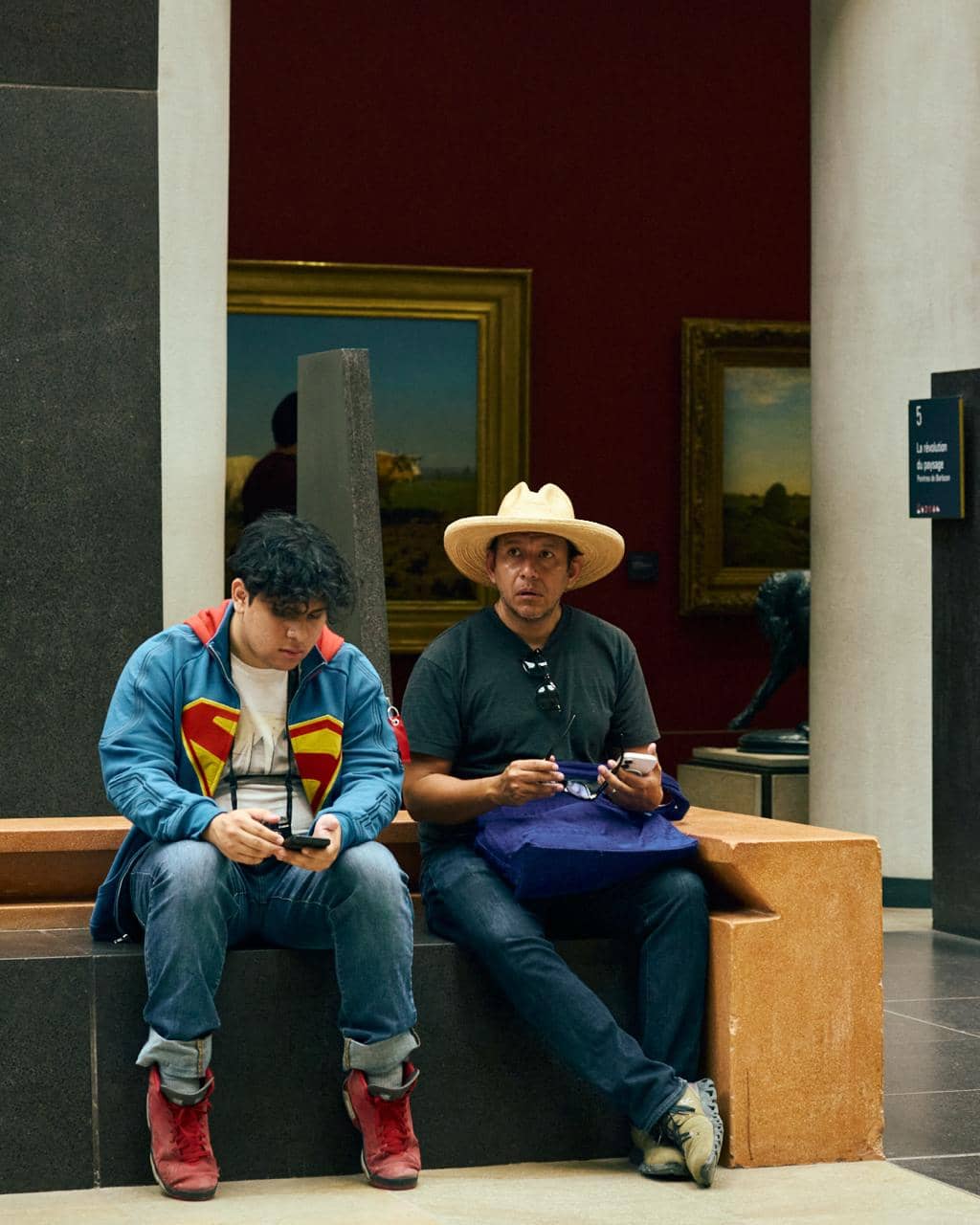
Deep red walls, gilt‑framed classical paintings. A modern two‑toned bench sits in the middle. On the left, a young man in a blue Superman hoodie, jeans, bright red sneakers, slumped over his smartphone. On the right, an older man in a wide‑brimmed straw hat, dark t‑shirt, jeans, holding sunglasses and a phone, gazing off‑camera with a surprised or thoughtful expression. A blue bag rests on his lap.
The title tells us: father and son. The relationship is assumed, not visible. What is visible is distance. The son is absorbed in the small screen, the father looks away, perhaps at the art, perhaps at nothing. The museum becomes a stage for parallel solitude.
The contrast feels almost too neat: youth digital, age contemplative; hoodie versus hat; slumped versus upright. Yet the photograph avoids simple judgment. The father also holds a phone; he is not immune. The son’s Superman logo hints at heroism, but his posture is anything but heroic. The image captures a moment where technology does not connect but isolates, even in shared space.
What holds the image together is the deep red of the walls. It envelops both figures, a colour of old grandeur, now backdrop to contemporary disconnection. The paintings hang silently, witnessing a scene they cannot interpret.
I distrust the ease of the generational reading, but the details resist simplification. The father’s hat is ridiculous, a tourist’s prop. The son’s sneakers are violently red. These touches ground the image in specificity, saving it from being a mere allegory of our times. The photograph is about this particular pair, in this particular museum, on this particular bench. That specificity is its strength.