I love Four - 2023
I love Four - 2023
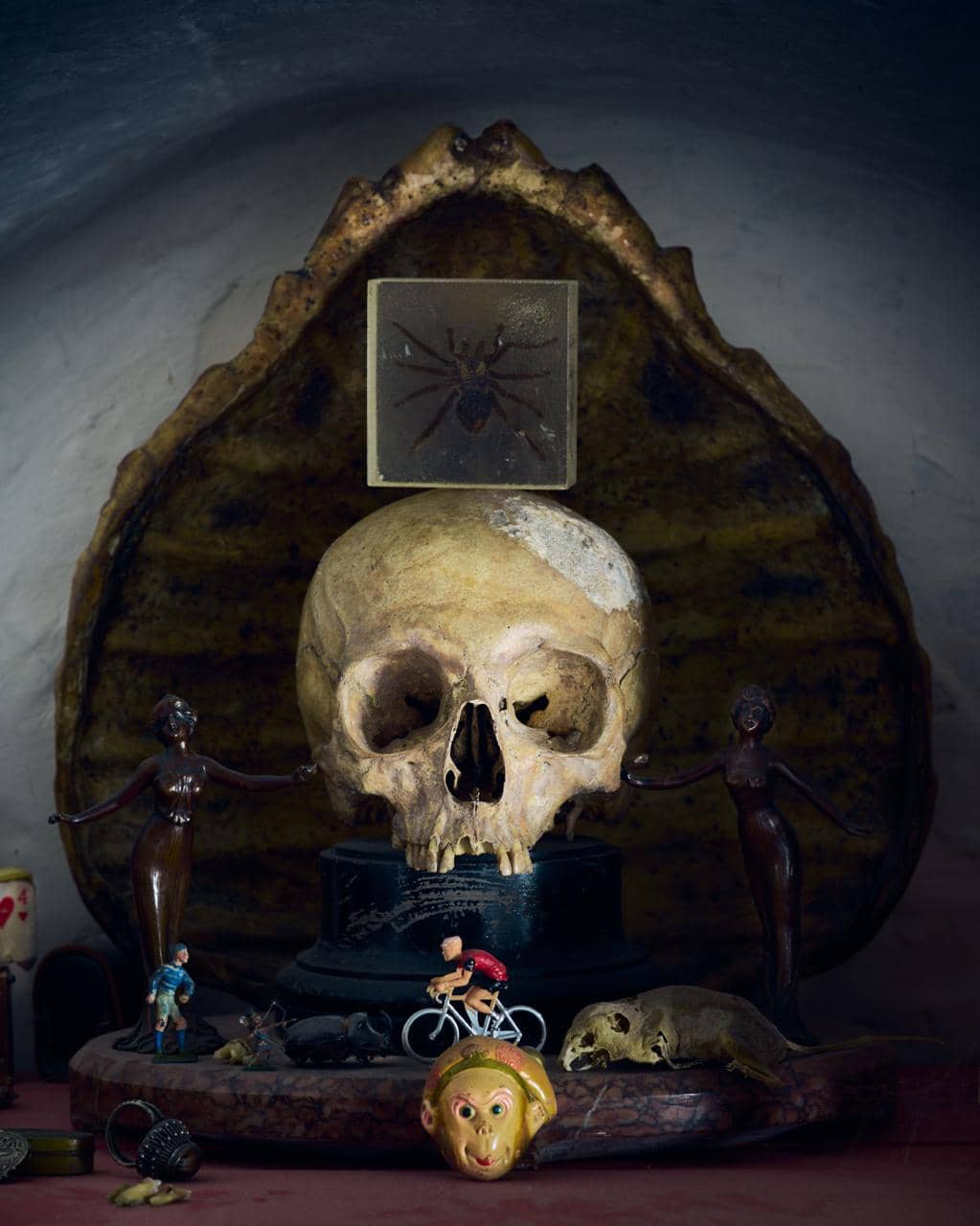
A human skull sits on a black pedestal. Behind it, a large, weathered arch curves like a bone or a shell; atop it, a framed picture of a spider. Two identical dark wooden figurines flank the skull—stylized female dancers with arms outstretched. At the base, a miniature cyclist, a soccer player, a small animal skull. In the foreground, a colorful cartoon monkey head grins.
The title says “I love Four.” The photograph does not. This is a still life that refuses to be solemn. The skull is central, but everything around it is play, sport, kitsch. The monkey head is almost silly. The spider in its frame feels like a collected specimen. The two dancers mirror each other, a pair of dark sentinels.
What holds this together? Not mood, but arrangement. The composition is tight, theatrical, almost over‑designed. Each element is a token: death, sport, pop, collectible, natural history. The image does not mourn death; it treats it as one more item in a cabinet of curiosities.
That feels both clever and cold. I am not sure whether the coldness is a failure or the point. The photograph is so controlled that it risks becoming a diagram. Yet the monkey head’s garish color saves it from pure calculation. The joke is allowed to sit in the foreground, grinning at the skull.
In Easy Realism, reality is trusted without polish. Here, reality is staged, curated, assembled. This is not Easy Realism; it is Studio Realism. The photograph knows it is constructing a metaphor, and does not hide the construction. That honesty may be its strength. But I miss the accidental, the unplanned, the grit that usually anchors Nieuwenhuys’ work. This feels like a set piece. Beautiful, but airless.