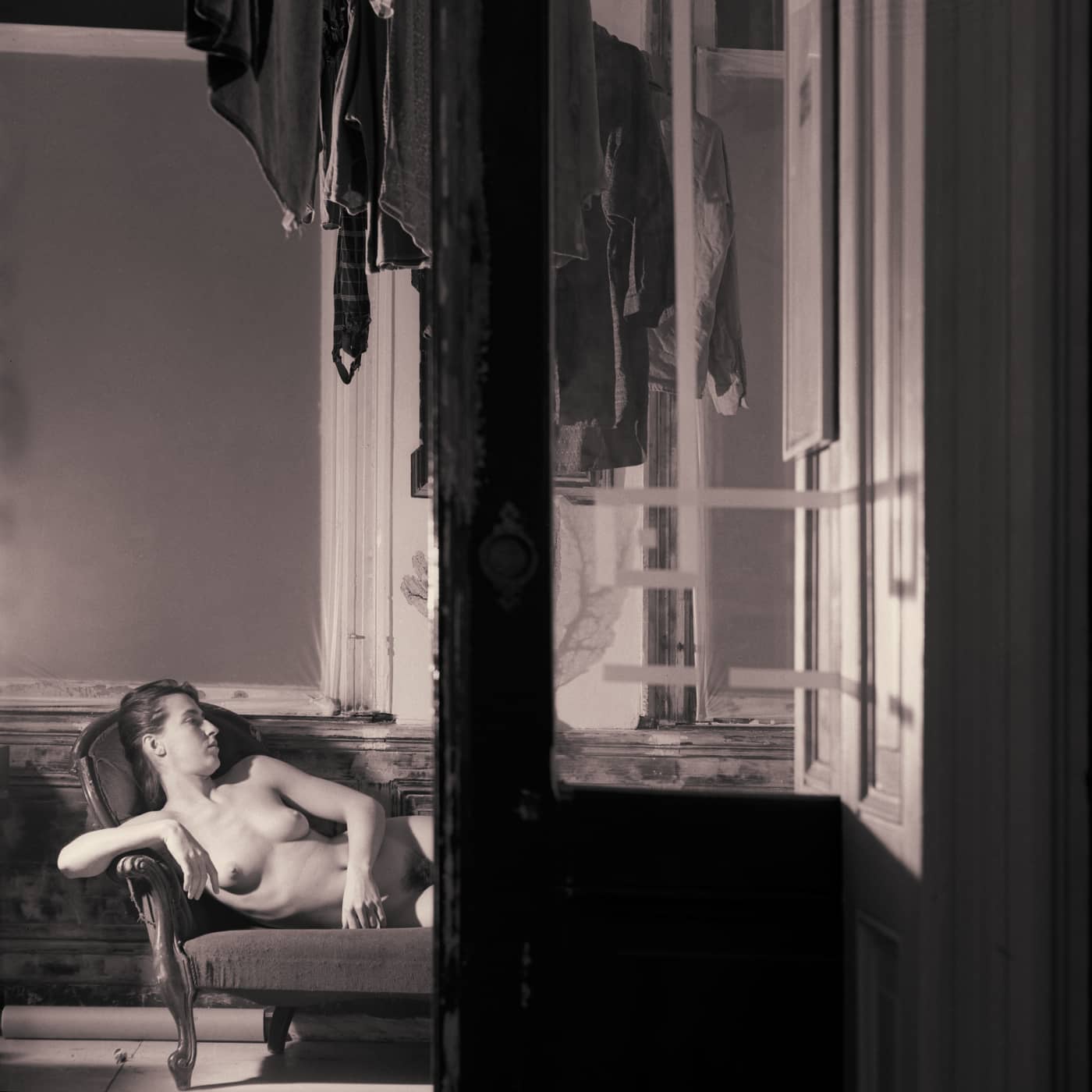
Nude in atelier - 1987
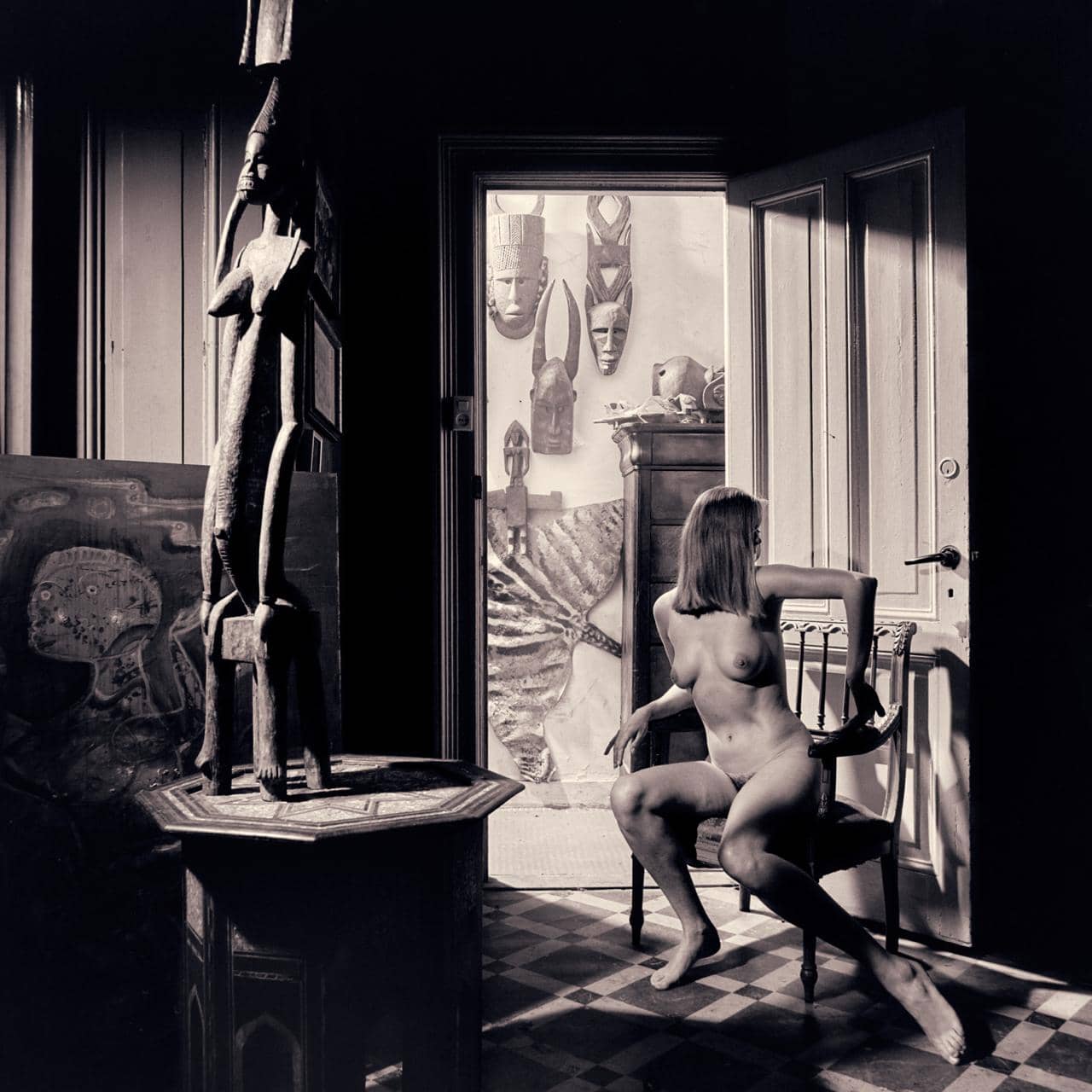
Nude in atelier - 1987
A checkered floor, stark black and white squares receding into shadow. A nude woman sits sideways on a wooden chair, her back partly turned, her face looking through an open doorway into a sunlit room. The light cuts hard, throwing her form into relief, drawing long shadows across the tiles. To her left, a tall, stylized African sculpture stands on a pedestal; beside it, an abstract painting. Through the doorway, African masks and carvings cover the wall.
The title says “Nude in atelier.” The studio is also a museum of objects, a collection. The African pieces are props, but their massed presence feels heavier than backdrop. They watch the room, the model, the camera. The model looks away, toward the light, maybe toward the masks, maybe at nothing. Her posture is relaxed, but the composition is tense: the hard geometry of the floor, the sharp light, the silent audience of artifacts.
This is 1987, late Bajazzo period. The image is flamboyant in its contrasts, its theatrical lighting. Yet the model’s gaze introduces a pause. She is not performing for the camera; she is looking elsewhere. That elsewhere is filled with objects that carry their own histories of display, of colonial collecting. The photograph doesn’t resolve that tension; it lets the tension sit in the frame.
I’m not sure the image knows what to do with the artifacts. They are décor, but they are also accusation. The nude, traditionally the object of the gaze, here looks away, while the masks stare back. That reversal is subtle, maybe accidental. But it’s where the picture becomes more than a stylish studio shot. It becomes a room where looking is complicated.