The Spirit of Our Time - 2021
The Spirit of Our Time - 2021
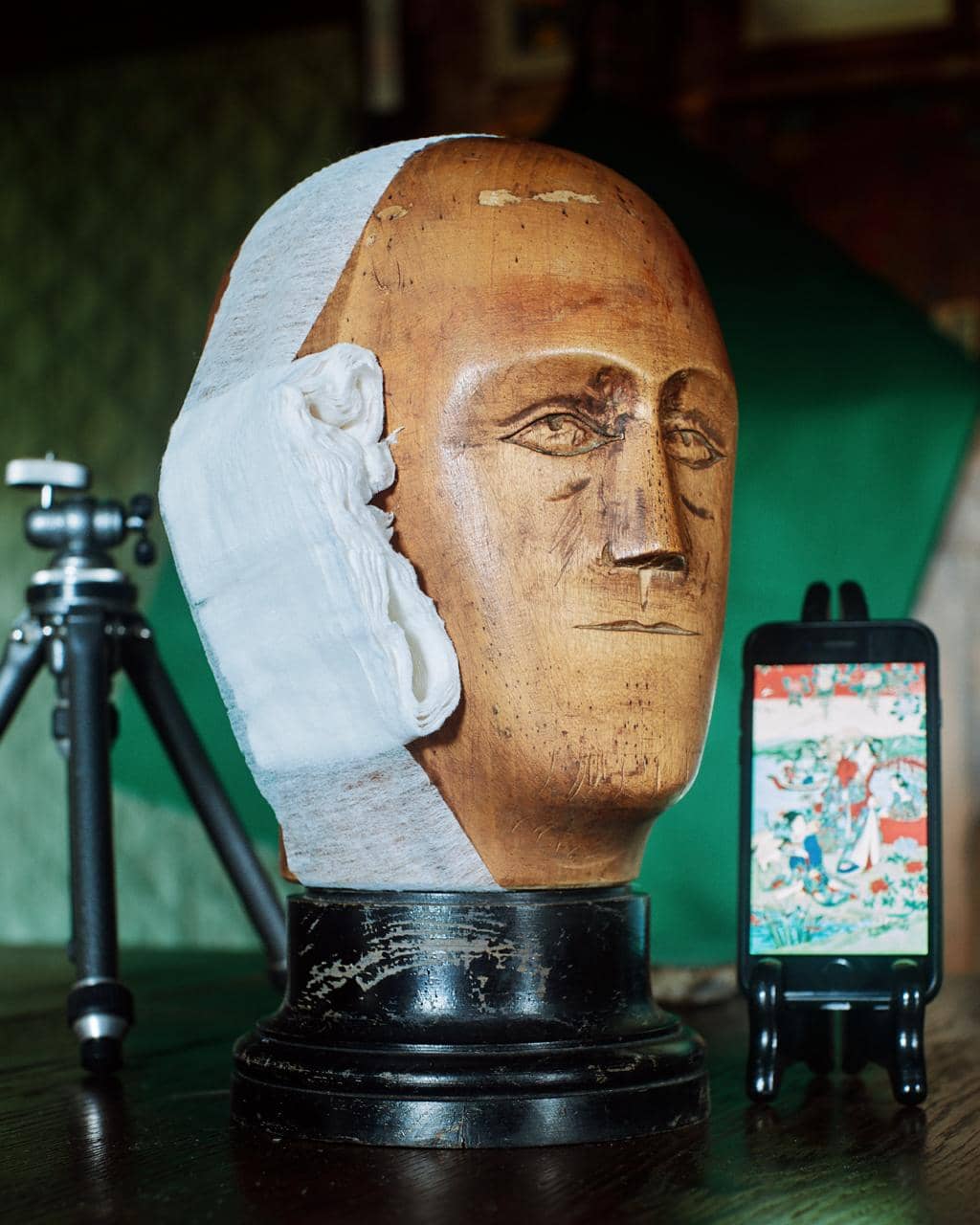
The photograph shows a carved wooden bust, its left ear wrapped in white gauze, resting on a scuffed black pedestal. To the left, a tripod stands ready; to the right, a smartphone screen glows with a colorful Japanese illustration. The green backdrop feels like a studio curtain.
The gauze references Van Gogh’s self-portrait with bandaged ear—the artist as wounded, romantic figure. The title, “The Spirit of Our Time,” lifts directly from Raoul Hausmann’s 1919 Dada assemblage, a critique of mechanized humanity. Here, the two historical artworks collide: the suffering individual meets the hollow, object‑filled head. But the bust is serene, eyes closed, almost Buddha‑like. The gauze looks temporary, maybe a repair, maybe a costume.
What troubles me is the smartphone. Its screen displays a vivid, intricate scene—traditional, hand‑made, perhaps ukiyo‑e—while the bust itself is carved wood, a tactile object. The tripod suggests documentation, but the phone is not filming the sculpture; it shows another image entirely. Is this our spirit now? A head wrapped in art‑history bandages, flanked by a tool of recording and a stream of digital imagery?
The picture is clean, lit softly from the left. It feels like a careful still life, not a provocation. I miss the roughness of Hausmann’s original, its angry clutter. This is a gentler homage, maybe too gentle. The sculpture is handsome, the composition balanced. I want something to snag, a tension that isn’t just referential. Instead, the image politely assembles its references and leaves them there, neat and undemanding.