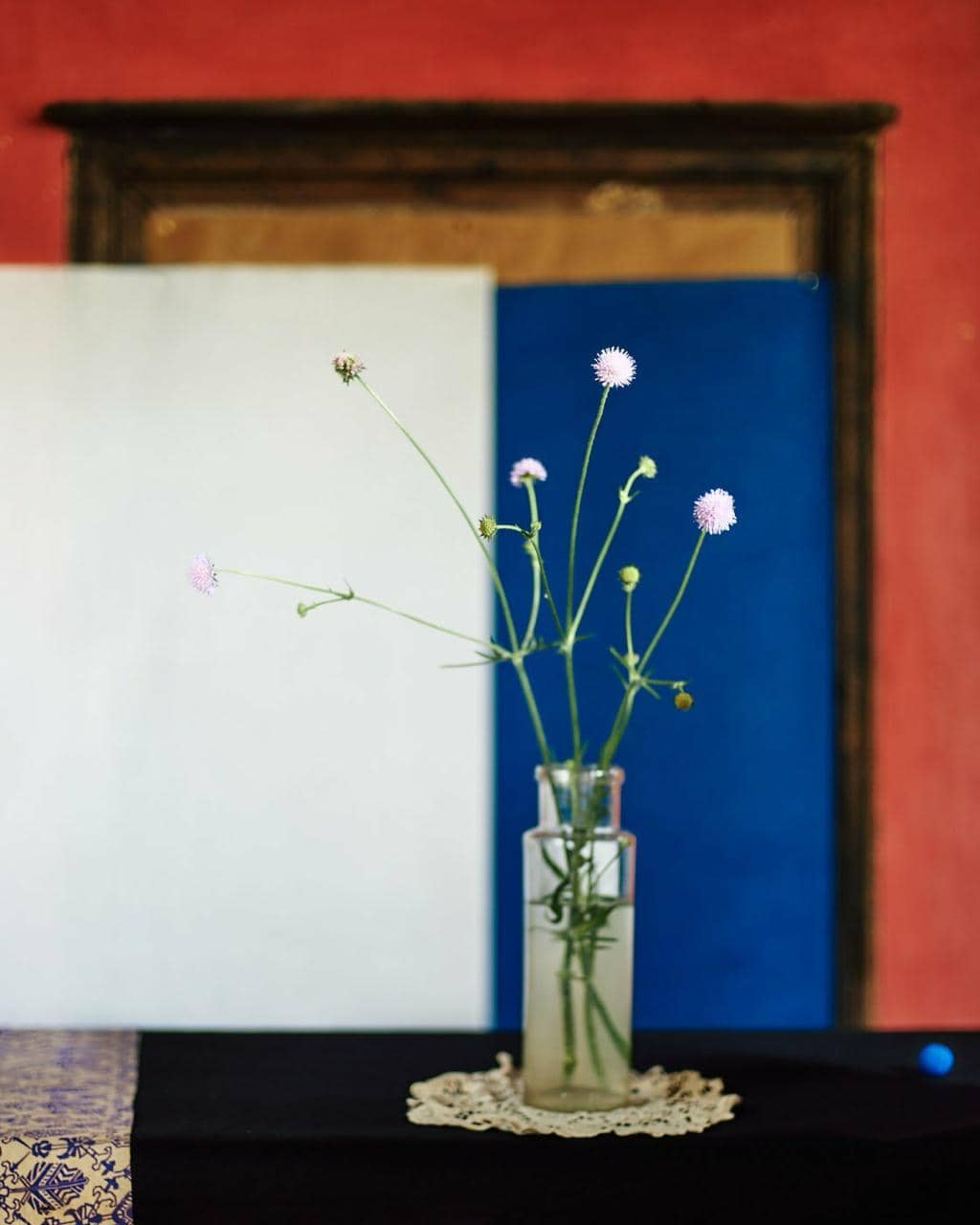
All the flowers are for you, only for you - 2020
All the flowers are for you, only for you - 2020
A clear glass vase holds a clutch of wildflowers—spiky pink heads, slender green stems—on a lace doily over a black cloth. Behind it, a dark wooden frame encloses two panels: one white, one saturated blue. The background wall is a matte red, textured with brushstrokes. At the right edge, a small blue sphere rests on the cloth.
The flowers look both delicate and stubborn. Their stems lean in different directions, refusing symmetry. The frame and panels suggest a painting or a stage set, but the flowers are real, already drying. The title, “All the flowers are for you, only for you,” feels like a whisper in a formal room.
What holds me is the tension between the natural and the arranged. The lace doily, the black cloth, the colored panels: everything is placed, yet the flowers retain a slight wildness. The shallow depth of field keeps the background soft, making the red wall feel like a backdrop, not a space.
I am not sure the blue sphere belongs. It feels like an extra note, a punctuation mark that doesn’t need to be there. The composition already has enough: the split panel echoes the vase’s verticality, the red wall warms the cool blues and whites. The sphere is a distraction, a small decorative gesture that weakens the photograph’s quiet insistence on the flowers themselves.
Still, the image works because it doesn’t try to be beautiful. The flowers are ordinary, the vase plain, the frame worn. The title promises intimacy, but the arrangement keeps a distance. That gap is where the photograph lives.