Philip Glass & Rob Malasch - 1985
Philip Glass & Rob Malasch - 1985
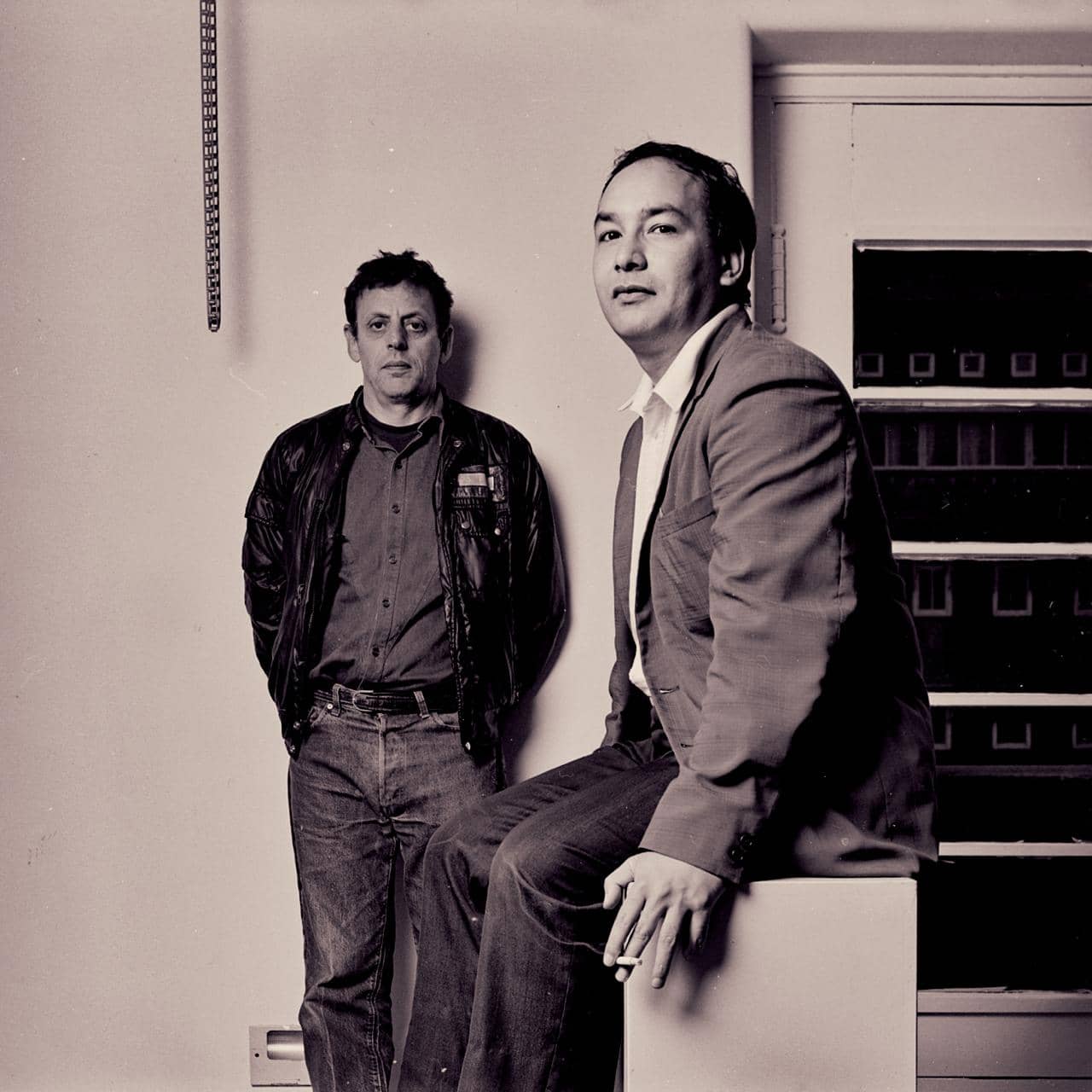
Two men in a minimal room. The man on the left stands against a plain wall, wearing a dark jacket over a button‑up shirt, jeans. He looks directly at the camera, serious, steady. The man on the right sits on a white block or low cabinet, suit jacket, collared shirt, a cigarette between his fingers. He gazes slightly off‑camera, contemplative. Behind them, a shelving unit holds dark, indistinct objects.
The title names them: Philip Glass & Rob Malasch. Philip Glass is the American composer, pioneer of minimal music. Rob Malasch is a Dutch gallery owner, art advisor. The photograph does not explain their relation. It places them side by side in a spare, almost stage‑like setting. The composition feels both casual and arranged.
This is 1985, the Rietveld / Bajazzo period. The image is flamboyant in its restraint. The minimalism of the room echoes Glass’s musical style—repetitive structures, clear lines. Yet the two men are not performing; they are simply present. The cigarette, the direct gaze, the slight distance between them—these are human details, not icons.
I am not sure whether the title adds too much. Knowing who they are layers the image with cultural weight, but the photograph itself does not rely on that knowledge. It works as a portrait of two individuals in a specific moment. The tension between the famous composer and the lesser‑known gallery owner is not highlighted; they are treated equally. That feels like a quiet political gesture.
The risk is that the image becomes merely a document of an encounter. But the framing, the light, the careful placement of the shelving unit behind them, suggest a deliberate composition. The photograph is not snapshot‑casual; it is considered. That consideration saves it from being just a meeting record.
What holds me is the cigarette in Malasch’s hand. It is a prop, but also a habit, a moment of pause. Glass stands without props, just his gaze. The two poses—standing firm, sitting relaxed—create a dialogue without words. The photograph does not need to spell it out. It trusts the viewer to read the space between them.