Self-Portrait - Time -1989
Self-Portrait - Time -1989
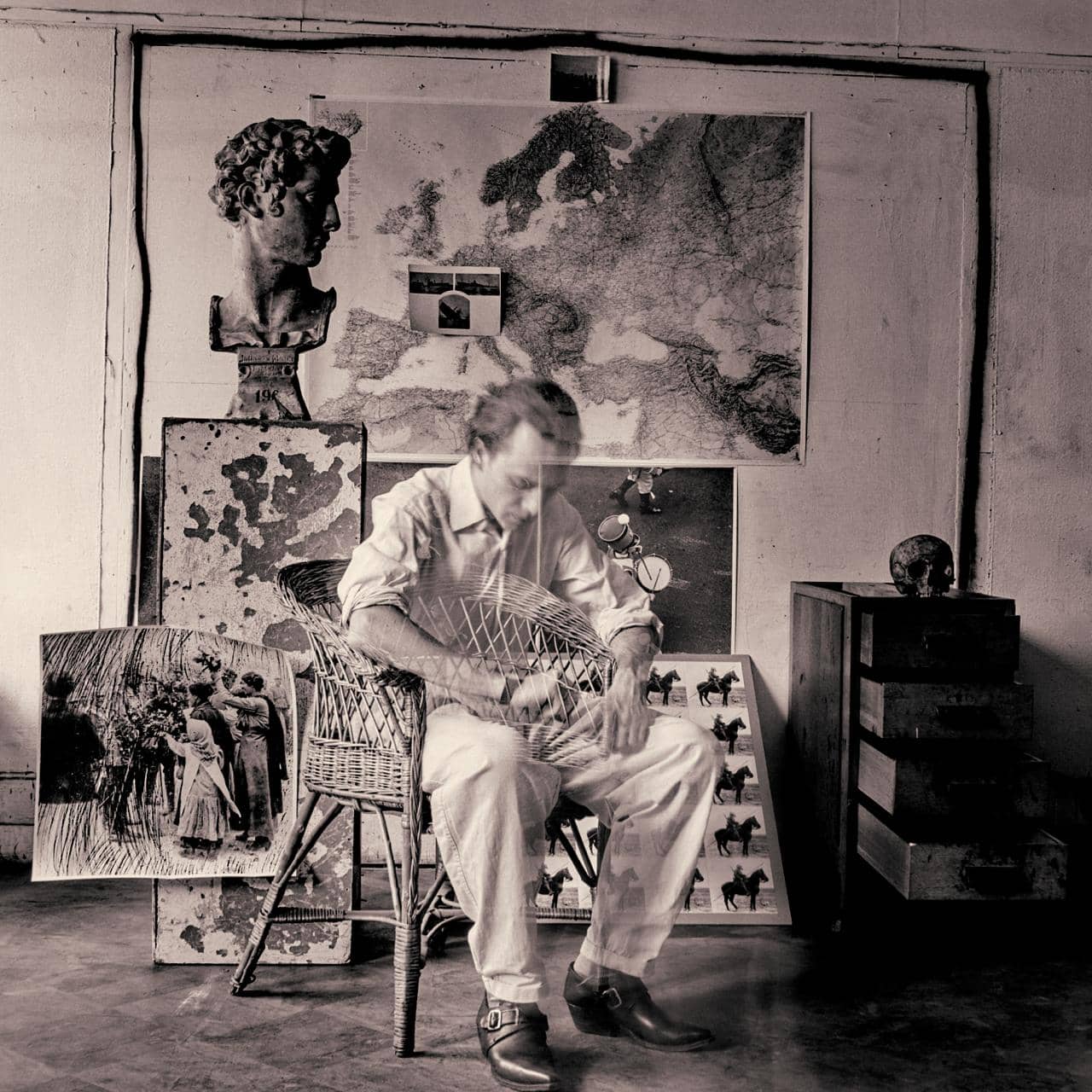
A wicker chair, a blurred figure. The man—the artist—sits in motion, a faint smear against the cluttered studio. Behind him, a large map of Europe covers the wall, flanked by a classical bust on a pedestal and a human skull on a wooden chest. Artworks lean everywhere: a photo of figures in a field, a sheet of repeated horse-and-rider images, a small picture pinned to the map. The space is dense with references, but the sitter is slipping out of focus.
The title calls it “Self-Portrait - Time.” The blur is the photograph’s first confession: time passes, and the self is not a fixed point but a trace. The skull on the chest is the second: time ends. The Bowie lyric— “I look at my watch, it says nine twenty-five / And I think ‘Oh God, I’m still alive’”—hangs in the air. It’s a sigh of survival, a surprise at continued existence. Here, the artist survives amid his own archive.
The map of Europe suggests a larger geography, maybe ambition or history. The bust and skull bracket the human span: classical ideal, mortal remains. The repeated horse-and-rider images hint at reproduction, maybe futility. The studio becomes a brain crowded with symbols, and the artist is the ghost moving through it.
I find the composition heavy-handed. The symbols feel like a checklist: time, death, art, geography. The blur tries to loosen the weight, but it’s a formal trick that doesn’t quite dissolve the symbolism. Still, the blur is where the picture lives. It admits that a self-portrait is always a record of a moment already gone. The artist is still alive, but the photograph is already a memory.
That admission—that the image is a record of disappearance—is stronger than the staged symbols. The studio is full of still things; the artist is the one thing that won’t hold still.