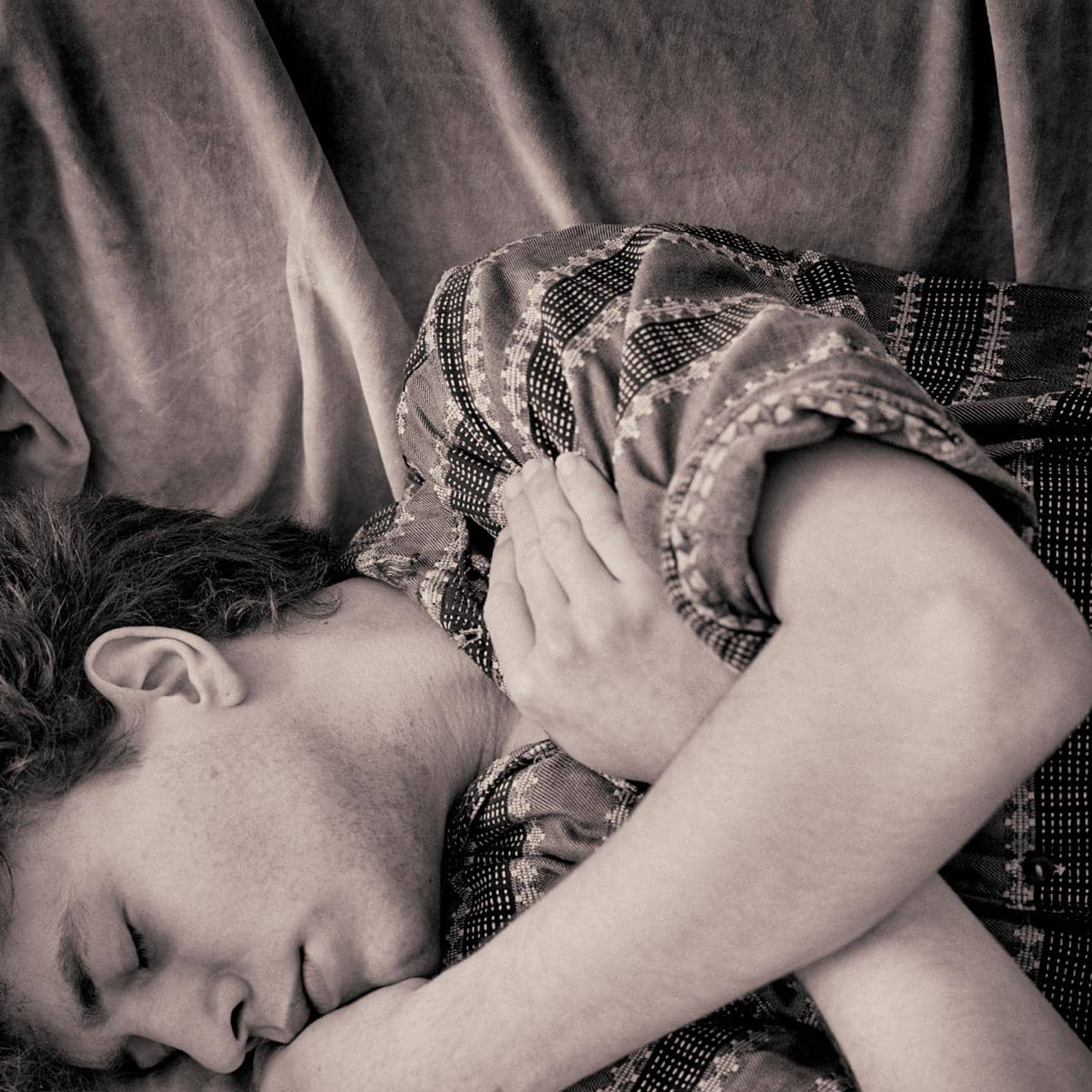
Self-Portrait Pretending to Sleep - 1984
Self-Portrait Pretending to Sleep - 1984
Curly hair frames a face with faint freckles. The eyes are closed, head resting on an arm, hand softly on chest. A patterned short‑sleeved shirt, rumpled fabric background. The angle is high, looking down, as if from the edge of the bed. The image feels intimate, serene, a moment of sleep.
But the title says “Self‑Portrait Pretending to Sleep.” The subject is not sleeping; they are performing sleep. That changes everything. The intimacy becomes a construction, the serenity a pose. This is 1984, the Bajazzo period, a time of flamboyance and public personas. Here, the persona is private, vulnerable, yet that vulnerability is staged.
What holds the image together is the tension between appearance and revelation. The photograph looks like a stolen moment, but the title admits it is a fabrication. That admission risks undoing the image’s emotional weight. If we know it’s pretend, can we still feel the quiet? I think we can, because the pretending is itself a kind of truth—the truth of wanting to be seen as asleep, as unguarded.
The risk is that the title does too much work, turning the photograph into a conceptual joke. Yet the details resist irony: the freckles, the curl of hair, the soft hand. They feel specific, lived‑in. The image is stronger than its concept. It shows that even a staged sleep can contain real weariness.
I distrust the ease of the revelation, but I trust the crease in the shirt, the faint shadow under the chin. The photograph earns its stillness, even if that stillness is a performance.