Der Song von Nein und Ja - 2021
Der Song von Nein und Ja - 2021
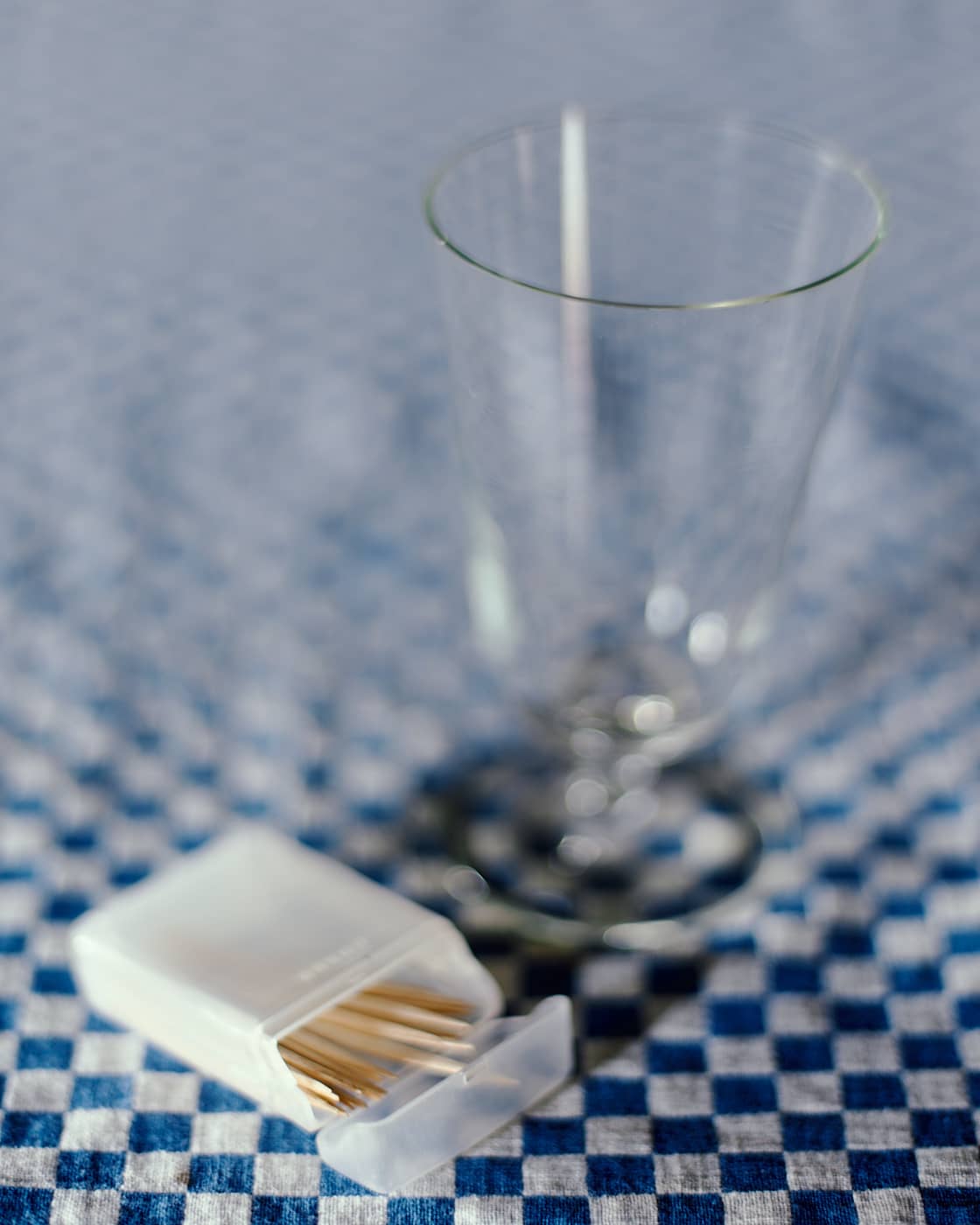
A clear glass stands empty. In front of it, a white plastic toothpick box lies open, its lid slightly ajar, the wooden sticks inside held in a tight bundle. Both rest on a blue and white checkered cloth, the fabric’s weave visible where it sharpens, the squares blurring softly around the glass. The light comes from the upper left, casting soft, diffused shadows. The focus is shallow: the toothpicks are crisp, the glass hazy, the background a gentle field of out‑of‑focus checks.
The photograph does almost nothing. That is its first risk. It refuses drama, symbolism, even composition as a noticeable gesture. The glass could be a vessel for anything or nothing; the toothpicks are just toothpicks. The checkered cloth is the kind you find in a kitchen drawer, not a studio prop. In an age of slick, hyper‑staged imagery, this feels like a refusal to perform. That refusal is the photograph’s primary tension.
Yet the title—German, poetic, a “song of no and yes”—loads the scene with a weight the image itself declines to carry. Is the empty glass “no,” the ready toothpicks “yes”? The pairing feels too neat, a little forced. The picture works better when you ignore the title and stay with the plainness: the slight puckering of the cloth, the faint embossing on the plastic box, the way the glass’s base distorts the pattern beneath it. Those details are where the looking earns its keep.
As a piece of Easy Realism, it trusts the mundane to hold interest without polishing. That trust is both its strength and its limitation. The photograph gives you nothing to hold onto except what is there—and what is there is very little. I am not sure whether that is a quiet victory or a polite dead end. The image leaves the question open, like the lid of the toothpick container.