The Lunch - 2025
The Lunch - 2025
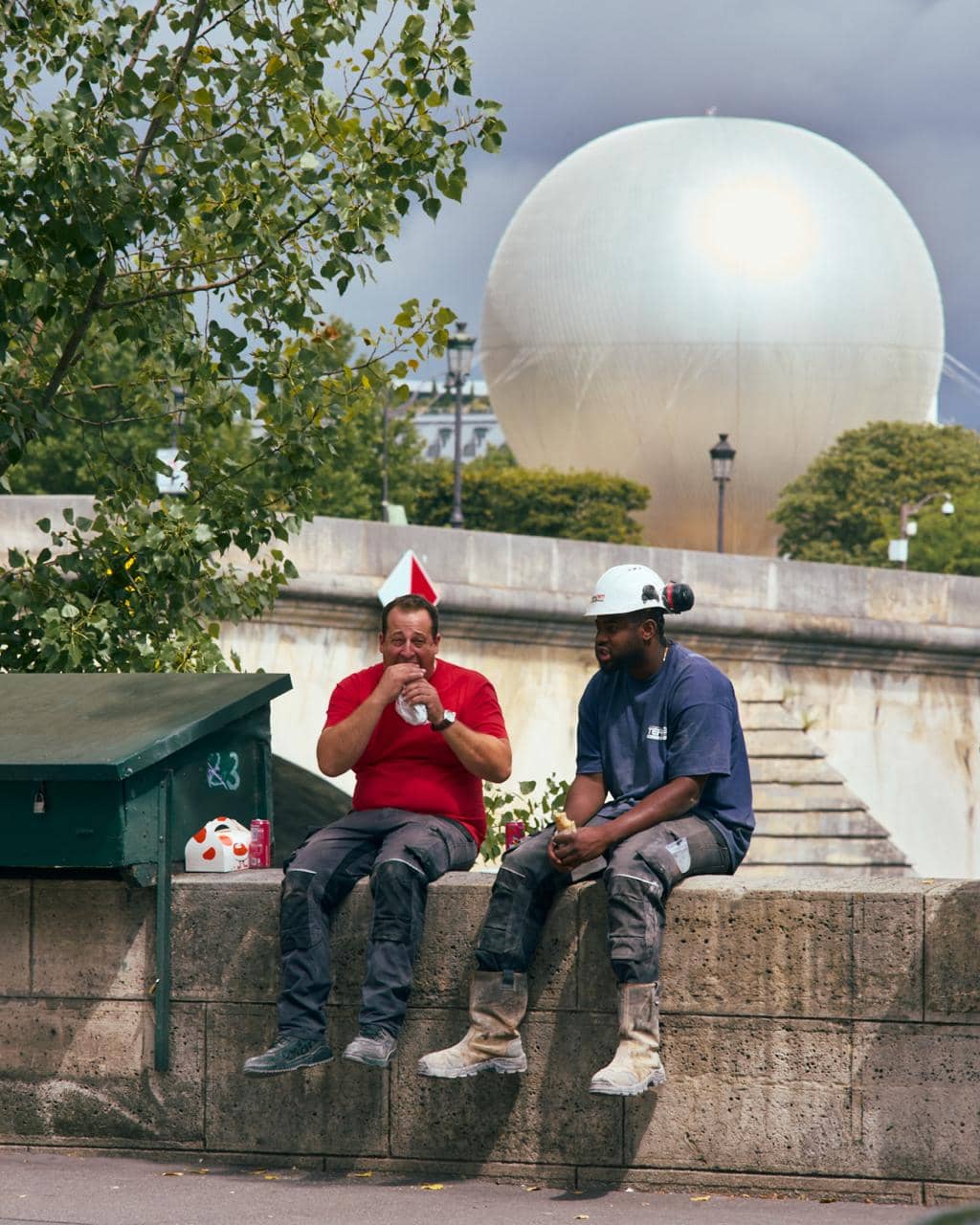
Two men sit on a stone ledge, eating lunch. The one on the left wears a red shirt, dark pants, eats from a white napkin. The one on the right wears a blue shirt, gray pants, a white hard hat, holds a sandwich, looks toward his companion. Between them a green trash bin holds a fast-food box and a red soda can. Behind them, a large, smooth, white spherical structure dominates the frame.
The sphere is the first thing you notice. It is too perfect, too white, too clean against the gritty setting. It feels like a temporary installation, a balloon, something that will be gone tomorrow. The men are not looking at it. They are focused on their food, on each other, on the break.
The contrast is not subtle. On one side: labour, fatigue, cheap lunch, trash. On the other: pristine geometry, public art, perhaps a symbol of something aspirational. The photograph does not force the reading, but the juxtaposition is too stark to ignore. It asks what we build, who enjoys it, who cleans up.
What holds the image together is the distance between the sphere and the men. They occupy the same space but different worlds. The framing is careful, almost too careful: the sphere centered, the men off to the side, the trash bin anchoring the foreground. The composition feels staged, but the weariness in the men’s postures feels real.
I’m not sure the photograph needs the sphere to make its point. The men and the trash alone would tell a story about work and respite. The sphere adds a layer of irony that borders on heavy-handed. Yet the image lingers because of that very heaviness. The white globe is so blatant, so obviously not theirs, that it becomes an accusation.
The title is simply “The Lunch”. No grand claims. The photograph gives us the lunch, the sphere, the distance between them. It does not explain. It shows.