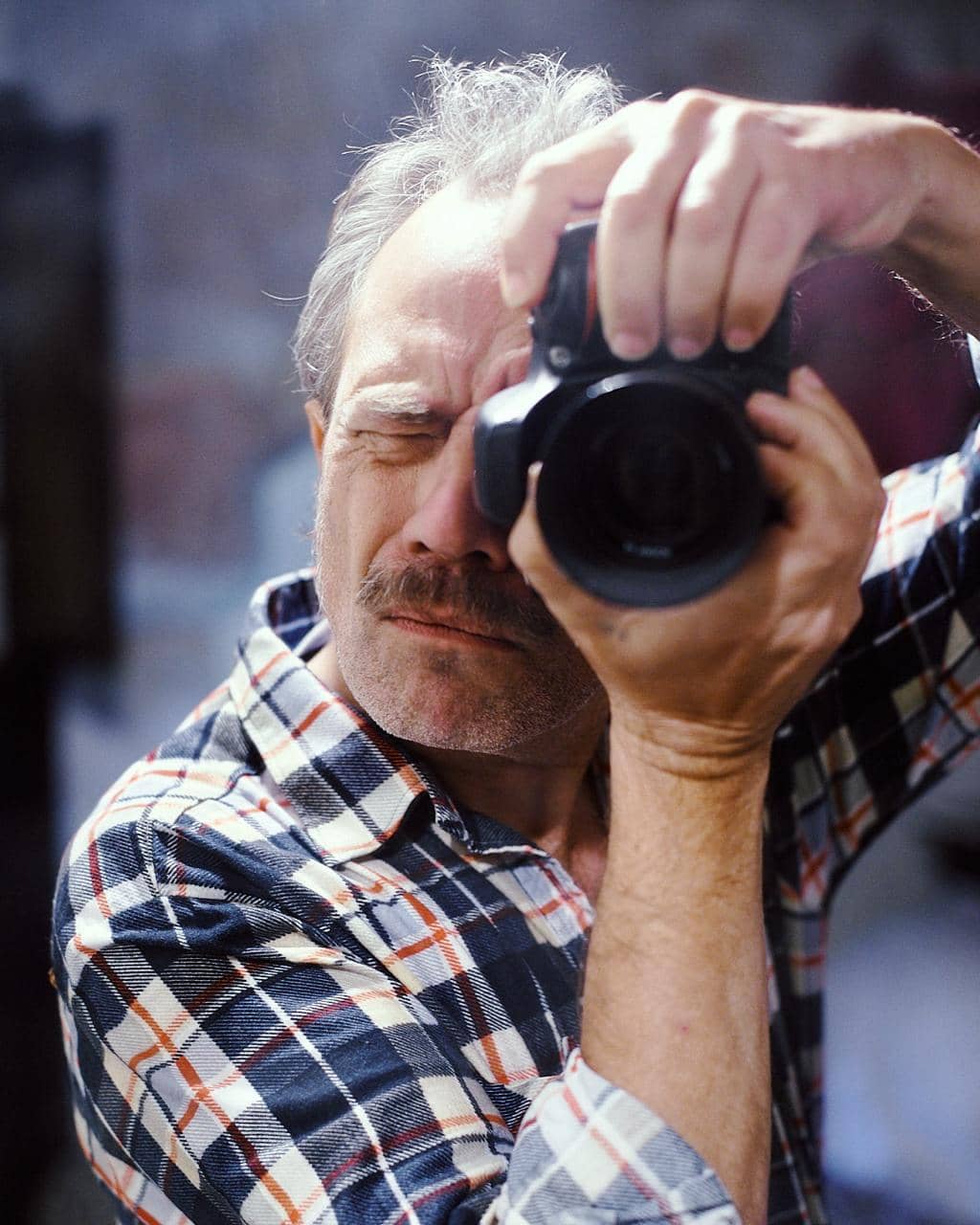
Selfportrait with moustache - 2020
Selfportrait with moustache - 2020
The photograph shows a man with a mustache and graying hair, holding a black digital camera to his right eye. His left eye is squinted shut. He wears a plaid shirt, blue and orange lines crossing at the shoulder. The background is a soft blur of muted tones.
The camera hides half his face; we see only one eye, the left one closed in concentration. The picture is a self‑portrait, but the photographer is looking elsewhere, aiming the lens at something we cannot see. That is the tension: he is both subject and operator, visible but not returning our gaze. The light falls from the upper left, highlighting his forehead and the top of his hand.
This belongs to Easy Realism, a period that trusts reality without polishing. Here, the reality is the act of photographing itself. The image is clean, sharply focused, unromantic. It does not dramatize the artist; it shows him at work, his shirt slightly wrinkled, his skin textured. I appreciate that plainness.
Yet I wonder if the picture is too comfortable. The composition is balanced, the shallow depth of field a standard technique. The mustache feels like a prop, a nod to classical portraiture that the image otherwise avoids. It is a competent self‑portrait, but I miss a wrinkle, something that snags. The photograph knows what it is doing, and does it well—maybe too well.